



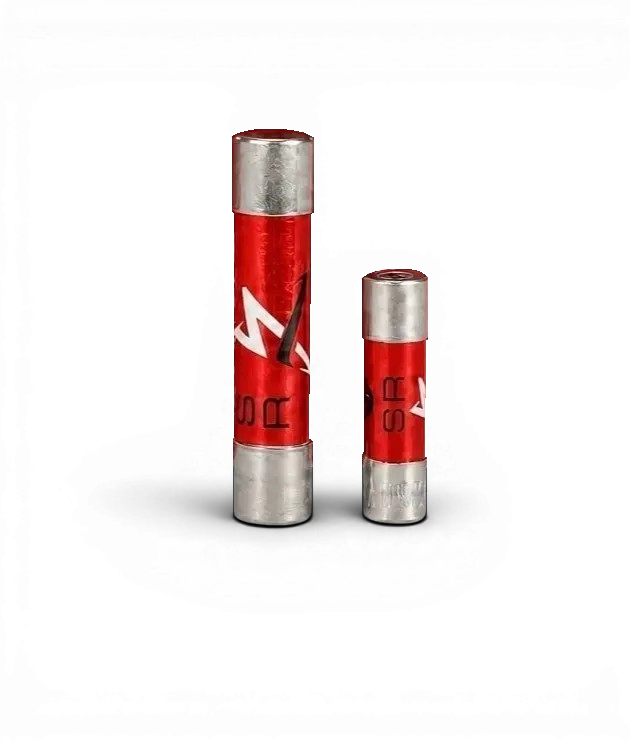
Synergistic Research
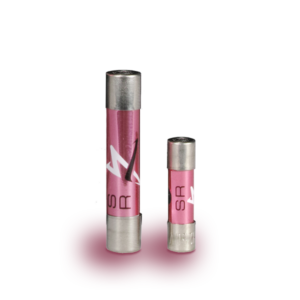
Holographic Fuses
5×20 & 6.3×32 mm
Incl. 21 % TAX € 269.00
- Worlds second best fuse!
- Ceramic body
- Silica filled
- Brass nickel plated contacts
- 1,000,000 Volt Quantum Treatment
- 2nd Stage Rev. 2.0 molecular realignment process
- UEF Treatment 2.0
- Graphene treated surface
- Greatly reduced break in time
- Time-delay or fast-acting
- Available in all usual current ratings
- Dimensions Ø 5×20 mm & Ø 6.3×32 mm (¼”x1¼”)
The Playing Field Just Got Bigger
The new Holographic Fuse generates the largest soundstage of any fuse Synergistic Research has ever built. Made with a UEF metamaterial that didn’t exist before. The new foundation of the SR fuse architecture — paired with the Master Fuse at the leading edge for its complete expression in one or two applications, like your DAC or power amplifier. A real breakthrough. Synergistic Research was chasing after a fuse, better capable of suppressing the negative side effects of MHz➜GHz noise – something present in virtually any digital device. At the same time, it had to work great in analog equipment too – better than the Pink Fuse it replaces. They succeeded, the Holographic Fuse was born.
To get there, SR needed a UEF metamaterial formulation more powerful than anything that was developed before. The new fuse had to maximally affect the MHz➜GHz contamination generated inside any digital device — absorbing it before it could migrate outward and degrade the noise environment the rest of the stages operate within. Working with a custom AI engineering system built on three decades of SR materials research and design principles, a four-part compounded UEF metamaterial was developed that would not have arrived through conventional material science alone. If SR had reached it without AI assistance at all, it would have taken many more years. When finally that UEF metamaterial formulation was applied to a fuse body — it resulted in the Holographic Fuse.
What does it sound like?
The Holographic Fuse throws the largest soundstage of any fuse Synergistic Research has ever made. In their reference system, the spatial envelope is roughly fifty percent larger than the Pink Fuse it replaces. That is a listening judgment made by the people who designed the product, in the room they designed it in, using ears that have been trained on this specific comparison for months. Not a subtle difference. A structural one.
SR fuses have always been known for holographic soundstage presentation. The Pink Fuse produced a genuinely three-dimensional image with depth, width, and spatial resolution that distinguished it from everything else in the category. The Holographic Fuse takes that existing three-dimensional envelope and expands it by approximately fifty percent. The images that were already floating in space migrate outward into a significantly larger room. The decay extends further before it resolves. What the Pink Fuse did well, the Holographic Fuse does on a larger scale with more air, more sense of physical space surrounding each image, more of the recording environment present in the listening room.
The resolution is high. But it never becomes etched. Never fatiguing. The detail is presented inside a large liquid space. The Pink Fuse by comparison was more pinpoint — tighter imaging, more leading edge definition, less liquid in its presentation, and in some systems capable of registering as fatiguing over extended listening. The Holographic Fuse is the opposite pole. Same resolution. Larger space. More liquid character. Zero fatigue. Musical and resolving simultaneously — the hardest combination to achieve and the one most fuses fail at.
Building Your Fuse Loom
Four starting points. One architecture. Every path below is protected by SR’s 30-day no-risk money-back guarantee. Audition it in your system. Take it as far as the system suggests.
✸ If you’re starting fresh:
Run Holographic Fuses everywhere. Every component. Every position. That is the simplest and most complete expression of what the Holographic Fuse architecture can do — the largest soundstage, the most air and decay, the most liquid presentation of resolution across the entire system simultaneously.
After listening, if you want more resolution and leading edge definition at the front of the signal chain — add one Master Fuse. In a digital system place it in your DAC. In an analog system place it in your phono stage or power amplifier. Everything else stays Holographic. The Master provides the leading edge anchor. The Holographic provides the spatial foundation the rest of the system operates within.
✸ If you have non-SR fuses in your system:
Non-SR fuses are the positions where the SR UEF Metamaterial architecture is not yet operating. Replacing them is the largest available improvement anywhere in the SR fuse lineup — larger than any upgrade between SR generations.
Start with one Holographic Fuse in your DAC, pre-amplifier or amplifier. The change will be immediate and structural. A larger soundstage. More air and decay. More liquidity. Resolution without fatigue. Add more Holographic Fuses one position at a time — your system will tell you when it’s right.
Once every non-SR fuse has been replaced with a Holographic — consider adding a Master Fuse at the front of the signal chain. In a digital system place it in your DAC. In an analog system place it in your phono stage or power amplifier. One Master at the leading edge. Holographic everywhere else. That’s the endpoint the system builds toward.
✸ If you have a Pink Fuse loom:
The Holographic Fuse replaces the Pink Fuse as the foundation of the SR fuse architecture — larger soundstage, more liquid, more musical, zero fatigue.
Keep the Pink Fuse on your DAC. Start with one Holographic Fuse downstream — your preamplifier, your amplifier, or any component away from the leading edge of the signal chain. Any application will exhibit the defining characteristics of the Holographic Fuse — a larger soundstage, more liquidity, more musicality, resolution without fatigue. Add more Holographic Fuses downstream one position at a time. With each addition the presentation grows larger and more musical. When to stop is determined entirely through your own listening. When you’re ready to go further – replace the Pink Fuse on the DAC with a Master Fuse. The Master does what Pink does in that position, but better in every way. One Master at the front of the signal chain. Holographic everywhere else. That’s the endpoint the system builds toward.
✸ If you have a Master Fuse plus Pink and Purple Fuses:
Purple comes out first. The gap between Purple and Holographic is the largest in the lineup — the improvement will be dramatic while preserving what it is you love about the Purple fuse — namely musicality with improved sound stage scale. Replace every Purple Fuse with a Holographic before touching the Pink Fuses already in the system.
Once the Purple Fuses are out, audition Holographic Fuses in the positions currently occupied by Pink — one position at a time, using the 30-day guarantee — until you have found the balance that best expresses the Holographic Fuse’s spatial and musical character in your specific system. Your Master Fuse stays where it is. It remains the leading edge anchor. The Holographic Fuses build the spatial architecture around it.
Every path through the SR fuse lineup converges on the same architecture — one Master Fuse at the leading edge, Holographic Fuses everywhere else. That’s the SR fuse architecture in its complete form. The exact balance is something your room and your ears decide.
The Voicing Principle
Every system is different. Every room is different. Every combination of components produces a different electromagnetic field environment that the UEF metamaterial fuse architecture operates within. The 30-day no-risk money-back guarantee exists precisely because the right balance is something the system reveals through listening — not something that can be specified in advance from the outside.
The principle is consistent across every system and every upgrade path. More Master Fuses — more analytical, more leading edge, more definition and grip. More Holographic Fuses — more spatial, more liquid, more musical, more air and decay into space.
Move in either direction until the system stops sounding like gear and starts sounding like music. That’s the point at which the voicing is right.
We from Kemp Elektroniks are so sure you’ll love what the SR Holographic and Master Fuses do for your system, we sell them with a no questions asked, 30-day money back guarantee so you can audition SR Fuses in your system risk-free. Then, if you’re not 100% satisfied with your system’s performance on SR Holographic and Master Fuses, return the fuses to us or your dealer in like new condition for a full refund.
Frequently asked questions:
Q: Are fuses directional?
A: Yes, fuses are directional. Electricity should flow from the left to the right when you view the fuse. If you do not know the direction of flow you should listen to the fuse inserted in both directions. One direction will sound more detailed. This is the correct way.
Q: Do fuses have a burn in period?
A: Yes, most products have a settling in period. The first 200-300 hours of use are the most crucial.
Q: Where should I use my Master fuse(s)?
A: To get the most out of our Master Fuses, we suggest starting with one or two fuses in most systems, and possibly more for highly resolving systems. There is no “wrong” component to start with; however, we typically recommend starting “upstream”, at the beginning of your signal source (music streamer, CD player, turntable, reel to reel, etc.). From there, we suggest moving on to your digital-to-analog converter or phonostage (if you use one), followed by your preamplifier and then your power amplifier. If you have multiple sources, upgrading the fuse in your preamplifier first can improve the performance of all of your sources.
Be the first to review “Synergistic Research
Holographic Fuses
5×20 & 6.3×32 mm”
You may also like…
Incl. 21 % TAX € 83.00
Incl. 21 % TAX € 10.00
Incl. 21 % TAX € 119.00
Related products
Incl. 21 % TAX € 109.00
Incl. 21 % TAX € 35.00
Incl. 21 % TAX € 269.00
Incl. 21 % TAX € 339.00
Reviews
There are no reviews yet.